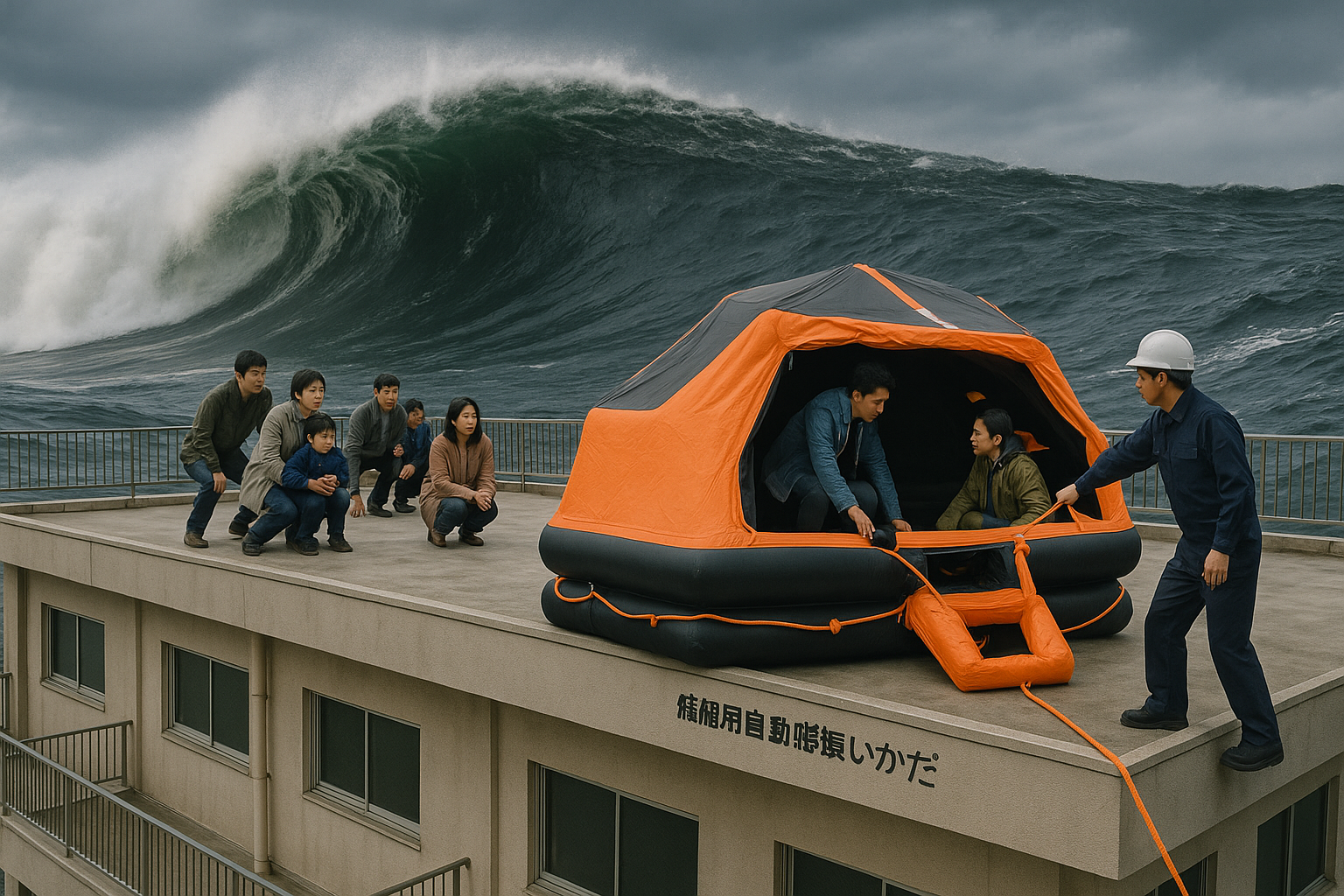
Shimizu District, Shizuoka City-According to the government’s new projections for a Nankai Trough megaquake, this area could be struck by a tsunami as high as 11 meters in as little as two minutes. When this estimate was first announced over a decade ago, the roughly 3,000 households and 6,000 residents of the district were shocked and forced to confront the reality: “How can we possibly escape in just two minutes?”

“If the tsunami comes rushing in just two or three minutes…”
“I honestly don’t think we’ll be able to escape.”
These voices reflect the harsh reality faced by the community. Within the neighborhood associations, discussions have continued around realistic countermeasures, with comments such as “It’s difficult to evacuate in two minutes” and “We’d need evacuation towers every 100 meters.”
Progress and New Challenges in Both Physical and Non-Physical Measures
Over the past decade, a 4-meter-high seawall has been constructed in the Shimizu district, and a new floodgate is being installed at the mouth of the Tomoe River. Annual evacuation drills and securing evacuation sites in buildings and condominiums have also raised residents’ awareness.
However, new challenges have emerged, such as an aging population due to the outflow of younger generations and an increasing number of people with mobility difficulties. “How to support and evacuate those who need assistance” has become a major theme for the future.
Facing the ‘2-Minute’ Reality-A New Option: The ‘Life Raft’
Our project, “Tsunami Safe-To Protect Lives from Tsunamis,” seeks to respond to the realities of the community by proposing the introduction of marine life rafts (tsunami survival capsules) as a new evacuation option.
While rapid evacuation to higher ground or evacuation towers remains the basic principle, in areas like Shimizu-where there is no nearby high ground and many elderly or disabled residents face mobility challenges-conventional evacuation methods alone have their limits.
Features of the Life Raft (Tsunami Survival Capsule)
- Can be installed near homes or facilities, minimizing evacuation distance
- Floats and withstands tsunamis of any height
- Equipped with food, water, and toilets, supporting up to 7 days of evacuation
- Designed for easy use by the elderly, infants, and people with disabilities-those most vulnerable during evacuation
- Can be introduced in small communities or at the facility level
The concept of “floating to survive,” born from lessons of the Great East Japan Earthquake, can become a new lifeline for coastal areas with high tsunami risk or communities where evacuation is difficult.
Together with the Community-Offering Diverse Options to Protect Lives
The “Tsunami Safe” project will continue working with residents of tsunami-prone areas, including the Shimizu district, to promote the adoption and installation of marine life rafts. By adding life rafts as “another option for survival” alongside evacuation towers and seawalls in local disaster prevention plans, we aim to build a society where everyone can protect their own life.
We will not give up in the face of the reality that “a tsunami will arrive in two minutes”-instead, we will confront it with diverse preparations.
The discussions and deliberations in the Shimizu district should serve as a valuable hint for tsunami-risk areas nationwide. Consider adopting the “float to survive” option in your own community as well.


コメント