
- Achieving “Zero Victims” in Tsunami Disasters: Evaluation Indicators and Social Implementation of Floating Devices
- “Tsunami Evacuation Support Devices” to Supplement the Challenges of Horizontal and Vertical Evacuation
- Evaluation Indicators for Tsunami Evacuation Support Devices: From the Perspective of Human capital, Resources, and Capital available
- LSA Code in the SOLAS Convention: Application to Tsunami Evacuation Support
- Potential of “Inflatable Liferafts” as Tsunami Evacuation Support Devices
- Conclusion: Promoting Technological Innovation and Social Implementation for Tsunami Disaster Prevention and Mitigation
Achieving “Zero Victims” in Tsunami Disasters: Evaluation Indicators and Social Implementation of Floating Devices
In recent years, there have been concerns about the occurrence of the Nankai Trough mega-earthquake and giant earthquakes along the Japan and Kuril Trenches, with devastating tsunami damage expected. In order to protect the lives of individuals, it is essential to consider and promote new measures in addition to conventional evacuation methods.
“Tsunami Evacuation Support Devices” to Supplement the Challenges of Horizontal and Vertical Evacuation
Since the Great East Japan Earthquake, various floating devices such as tsunami lifeboats and tsunami shelters have been proposed. However, issues such as delays in evacuation due to low awareness of tsunami risks, inappropriate actions, and confusion during evacuation due to lack of training have been raised. In addition, it may be difficult for people in areas with short time between the earthquake and tsunami arrival, and for people who require time for evacuation such as the elderly and people with disabilities, to evacuate to a safe place. Furthermore, in areas with many low-rise buildings, it is difficult to secure vertical evacuation sites, and there are concerns about insufficient supplies at evacuation sites.
In order to complement these challenges, the use of “tsunami evacuation support devices” is attracting attention. This article examines indicators that can compare and evaluate tsunami evacuation devices, and aims to promote the spread of new devices.
Evaluation Indicators for Tsunami Evacuation Support Devices: From the Perspective of Human capital, Resources, and Capital available
By organizing the elements necessary for tsunami evacuation support from the perspective of “people, goods, and money” and comparing and evaluating existing devices, we will clarify the important elements for the purpose of popularization.
| Aspect | Item | Content |
|---|---|---|
| Human capital | Education and Training | Easy to educate on how to use, easy to use in training |
| Awareness | Many people have seen and heard about it | |
| Ease of Operation | Anyone can easily use and operate it regardless of the user | |
| Laws and Regulations and Certification | Clears domestic and international regulations and certifications | |
| Resources | Material Strength | Withstands strong impacts and collisions with sharp debris |
| Heat Resistance, Fire Resistance | Resistant to heat and fire, and difficult to burn | |
| Flood Prevention | Highly airtight and prevents water from entering | |
| Buoyancy | Does not sink and maintains a floating state on the water | |
| Stability | Difficult to capsize and maintains a certain orientation | |
| Measures against Damage/Breakage | Introduction of double structure and buoyancy aids | |
| Temperature Control | Can keep the internal temperature relatively constant | |
| Oxygen Supply | Does not interfere with breathing even when evacuating underwater | |
| Speed of Deployment and Use | Can be used immediately in an emergency | |
| Ease of Storage and Transportation | Space saving is considered, and storage and transportation are possible | |
| Capital available | Productivity | Supply can be met according to demand by establishing a production line |
| Introduction Cost | Price setting that individuals and general households can purchase | |
| Maintenance Cost | Low cost for regular inspections and maintenance |
Existing tsunami evacuation support devices (life jackets, tsunami shelters, tsunami evacuation towers) have biased strengths and weaknesses, and social implementation is difficult. In order to achieve popularization (= social implementation), it is necessary to satisfy the above elements.
LSA Code in the SOLAS Convention: Application to Tsunami Evacuation Support
The LSA Code (International Life-Saving Appliance Code) in the SOLAS Convention (International Convention for the Safety of Life at Sea) has many points in common with the elements required for tsunami evacuation support. The LSA Code is an international treaty that sets safety standards for ships and the installation of life-saving equipment, and mandates the installation of evacuation equipment.
LSA Code-compliant equipment meets the following requirements:
- Capacity: Can accommodate the expected number of people
- Inflation Method: Equipped with automatic inflation and manual inflation functions using compressed gas
- Stability: Self-righting structure that returns to its original position even when inverted, and stability is ensured by ballast bags (water bags)
- Materials and Durability: Weather-resistant, abrasion-resistant, and corrosion-resistant materials, resistant to ultraviolet rays, seawater, and oils
- Equipment and Supplies: Drinking water, emergency food, signaling equipment, first aid supplies, rainwater collection devices, and lighting equipment for nighttime use
- Protective Structure: Cover (canopy) to protect against wind and rain, and design that can be used in cold regions
- Buoyancy: Ensures buoyancy even when fully loaded, and has a structure that does not sink even when flooded
- Deployment Speed and Storage: Can be inflated and used within 1 minute, and can be stored compactly when stored
- Operating Temperature Range: Operates normally in the temperature range of -30℃ to 65℃
- Inspection and Maintenance: Design that allows for regular inspection, with expiration dates and inspection labels
By utilizing LSA Code-compliant products that meet these requirements as tsunami evacuation support devices, benefits such as low cost, all-weather compatibility, compact design, rapid use, high buoyancy and stability, and accommodation of many people can be expected.
Potential of “Inflatable Liferafts” as Tsunami Evacuation Support Devices
“Inflatable liferafts” can be expected to be used as tsunami evacuation support devices. In fact, a nursing home with assisted living in Shimizu Ward, Shizuoka Prefecture, has installed a 25-person liferaft on the roof and conducts training every year including local residents.
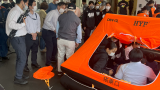

Inflatable liferafts can be used in the following ways:
- Installation in facilities for people who need support during disasters (hospitals, schools, kindergartens, nursing homes, etc.)
- Installation in places where many unspecified people gather (shopping centers, tourist attractions, public facilities)
- Installation in tsunami evacuation areas (high ground, tsunami evacuation designated buildings, tsunami evacuation towers, etc.)
- Installation on the premises and buildings of port facilities, factories, fishing ports, etc.
These applications can ensure the safety of people who need support during disasters and tourists, respond to risks in areas where tsunami arrival is expected in a short time, reduce installation costs, and enable flexible operation.
Conclusion: Promoting Technological Innovation and Social Implementation for Tsunami Disaster Prevention and Mitigation
LSA Code-compliant devices have the potential to complement the challenges of current tsunami evacuation methods. By correctly understanding the performance of each device, it may be possible to connect to more optimal tsunami disaster prevention and mitigation measures for each region.
Tsunami disaster prevention and mitigation means that even industries/businesses that appear to be different have the potential for existing technologies and products to greatly contribute to “tsunami countermeasures.” It is necessary to continue to promote improvements through technological innovation and social implementation, and to promote efforts to establish a tsunami evacuation system that everyone can use.
Disclaimer
This article is based on the attached materials and does not guarantee the accuracy or safety of the contents. For final decisions regarding tsunami evacuation, please follow the instructions of the relevant organizations.