
In recent years, Japan has been concerned about the occurrence of massive earthquakes along the Nankai Trough and the Japan Trench-Kuril Trench, which could potentially cause devastating tsunami damage. In addition to conventional evacuation methods, it is essential to consider and implement new countermeasures.
Challenges in Tsunami Evacuation and the Potential of Marine Life Rafts

There are two methods of tsunami evacuation: horizontal and vertical. However, each has its challenges. For example, in areas where the time between an earthquake and tsunami arrival is short, or for elderly and disabled individuals who require more time to evacuate, reaching a safe location can be difficult. Additionally, in areas with many low-rise buildings, securing vertical evacuation sites can be challenging, and there are concerns about insufficient supplies at evacuation sites.
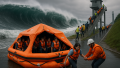
As a new option to complement these challenges, the use of marine life rafts is gaining attention. Life rafts compliant with the LSA Code (International Life-Saving Appliance Code) under the SOLAS Convention (International Convention for the Safety of Life at Sea) meet many of the requirements for tsunami evacuation support.
Features of LSA Code-Compliant Life Rafts
LSA Code-compliant life rafts have the following characteristics:
- High safety: Self-righting structure and stability ensured by ballast bags
- Durability: Made with weather-resistant, abrasion-resistant, and corrosion-resistant materials
- Equipped with necessary supplies: Drinking water, emergency food, signaling devices, first aid supplies, etc.
- Protective functions: Canopy to protect against wind, rain, and waves; designed for use in cold regions
- High buoyancy: Maintains buoyancy even when fully loaded and won’t sink even if flooded
- Rapid deployment: Inflates and becomes usable within one minute
- Compact storage: Space-efficient design when stored
- Wide operating temperature range: Functions normally from -30°C to 65°C
- Maintainability: Designed for regular inspections, with expiration dates and inspection labels
Utilization as a Tsunami Evacuation Support Device
Marine life rafts can be installed in various locations, including:
- Facilities housing vulnerable populations during disasters (hospitals, schools, kindergartens, nursing homes, etc.)
- Places where large numbers of people gather (attractions, tourist spots, public facilities)
- Tsunami evacuation sites (high ground, designated tsunami evacuation buildings, tsunami evacuation towers)
- Port facilities, factories, fishing ports, and other premises or structures
In fact, a fee-based nursing home for the elderly in Shimizu Ward, Shizuoka Prefecture, has installed a 25-person life raft on its roof and conducts annual drills involving local residents.
Benefits of Using Marine Life Rafts
- Cost-efficiency: Lower cost per person compared to other tsunami countermeasures (seawalls, evacuation towers, etc.)
- Flexibility in installation: Can be installed in various locations
- Application of existing technology: Utilizes the basic life-saving functions of marine life rafts for tsunami countermeasures
- Multifunctionality: Equipped with necessary functions for tsunami evacuation, such as buoyancy, stability, and impact resistance
- Rapid deployment: Can be quickly used in emergencies
- Storage efficiency: Can be compactly stored during normal times
Challenges and Future Prospects
There are several challenges in utilizing marine life rafts as tsunami evacuation support devices:
- Legal regulations and certification: Legal framework for land-based use
- Education and training: Dissemination of usage methods and regular evacuation drills
- Maintenance system: Establishment of systems for regular inspections and repairs
- Cost reduction: Reducing introduction and maintenance costs through mass production
- Adaptation to regional characteristics: Customization according to tsunami risks in each area
By overcoming these challenges and combining them with existing evacuation methods, more effective tsunami countermeasures can be achieved.
Conclusion
The utilization of marine life rafts for tsunami countermeasures holds great potential as a new option to complement conventional evacuation methods. It can be particularly effective for those who have difficulty evacuating and in areas where tsunamis arrive quickly. Moving forward, it is important to advance technological development and social implementation while incorporating these measures into optimal evacuation plans tailored to regional characteristics.
Tsunami disaster prevention and mitigation can potentially make significant progress by flexibly applying existing technologies and products. The utilization of marine life rafts is one example, and it is necessary to continue gathering knowledge from various fields to establish a system where everyone can evacuate safely.

コメント