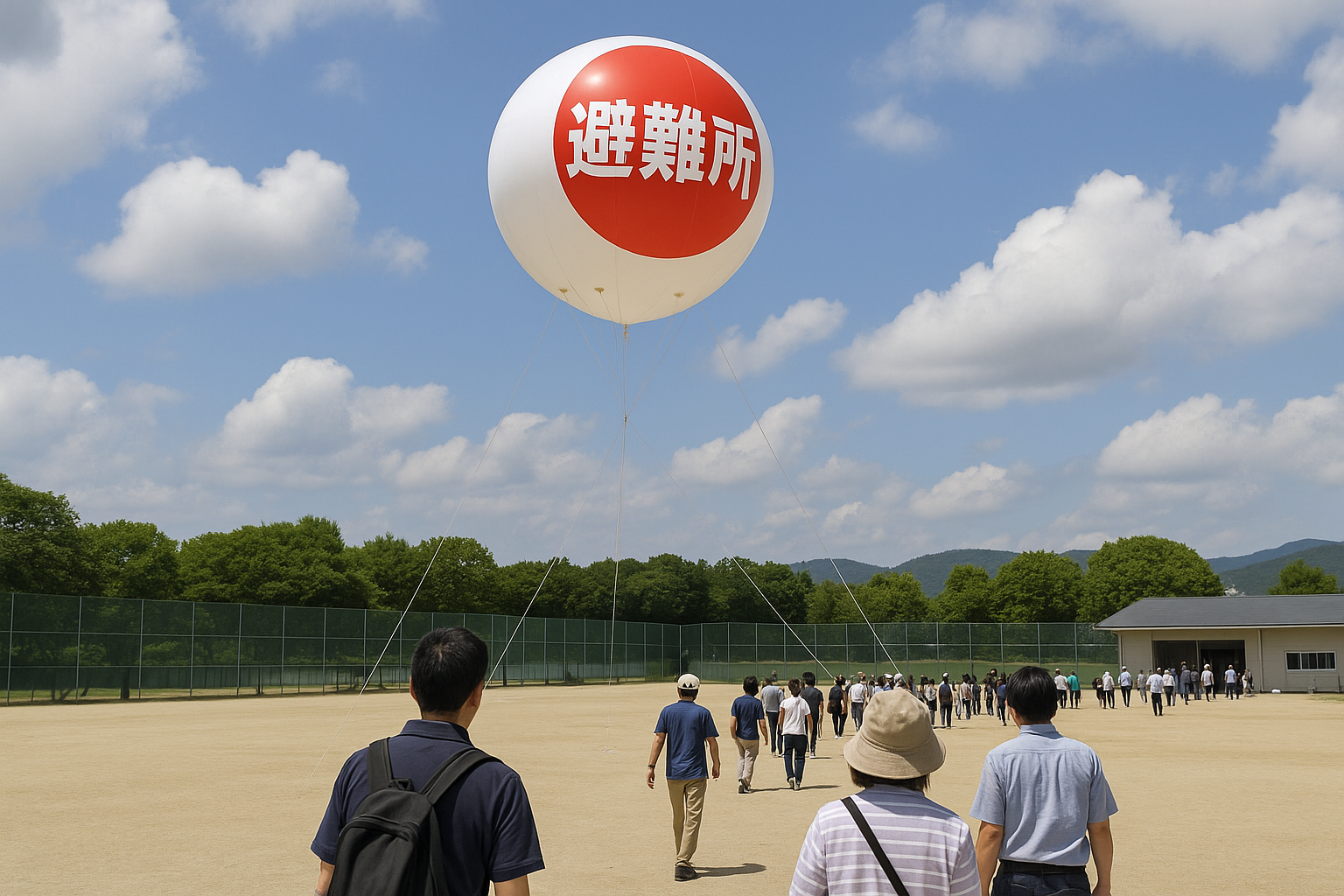
In March 2025, an automatic deployment test of balloon-type evacuation markers indicating tsunami evacuation sites was conducted at the S-Pulse Dream Plaza in Shizuoka City, Shizuoka Prefecture. This innovative initiative, led by the “Tsunami Balloon Project” student group from Tohoku University, aims to quickly and visually indicate evacuation locations during a tsunami event.

Project Background
Lessons learned from the Great East Japan Earthquake have led to the exploration of new evacuation guidance methods to minimize human casualties from tsunamis. Recognizing evacuation sites immediately during emergencies is particularly challenging for tourists and foreigners unfamiliar with the area. To address this issue, Shunnosuke Narita, a graduate student at Tohoku University, initiated research on an evacuation guidance system using advertising balloons.
Features of the Balloon-type Evacuation Markers
The system’s main feature is its visibility and rapid deployment. When a tsunami warning is issued, red balloons automatically rise from evacuation buildings and tsunami evacuation towers. The balloons display large text such as “Evacuation Site,” designed to be easily identifiable from a distance.
Results and Challenges of the Demonstration Experiment
The demonstration experiment on March 12, 2025, confirmed the entire sequence from balloon inflation to ascent. Results showed the potential to reduce the time for the balloon-type evacuation marker to function to as little as 2 minutes.
However, challenges were also identified. Ensuring visibility in adverse weather conditions like strong winds and rain, legibility of text from long distances, and balancing rapid deployment with safe retrieval are areas requiring further improvement for practical implementation.
Importance of Diverse Evacuation Guidance Methods
Professor Fumihiko Imamura, Director of the International Research Institute of Disaster Science at Tohoku University, emphasizes, “While various means such as disaster prevention radio and smartphones exist, which ones are usable depends on the situation. The simpler, the easier to respond to in disasters, and it’s crucial to guide using diverse methods.”
Consideration for Inbound Tourists
With the increasing number of foreign tourists visiting Japan, the need for evacuation guidance that transcends language and cultural barriers is growing. Balloon-type evacuation markers are expected to significantly contribute to ensuring the safety of inbound tourists as they can visually indicate evacuation sites without relying on language.
Future Prospects
The “Tsunami Balloon Project” aims for full-scale practical implementation of balloon-type evacuation markers by fiscal year 2027. They plan to strengthen collaboration with manufacturing industries and utilize existing technologies to develop a safer and more effective system.
Conclusion
The Tsunami Balloon Project is a crucial step towards realizing “a world without tsunami deaths.” Building an evacuation guidance system that is easily understandable not only for local residents but also for tourists and foreigners is extremely important from a lifesaving perspective. Continued improvement of the technology and further demonstration experiments are expected to establish a more effective evacuation guidance system.
This innovative approach, if spread throughout Japan and eventually to tsunami-risk areas worldwide, could be a significant aid in bringing tsunami casualties close to zero. We need to continue our efforts towards building a safe and resilient society by combining technological innovation with local wisdom.

コメント